Key Takeaways & AI Summary
- The definitive 2026 Generative Engine Optimization (GEO) and AI Overview (AIO) guide for moving companies to get recommended by Google Gemini, ChatGPT, Claude, Grok, and Perplexity.
- Core Industry Topic: AI search for moving companies
- Core Industry Topic: Generative Engine Optimization moving industry
- Core Industry Topic: how to rank moving company on ChatGPT
- Core Industry Topic: Google Gemini AI Overviews moving leads
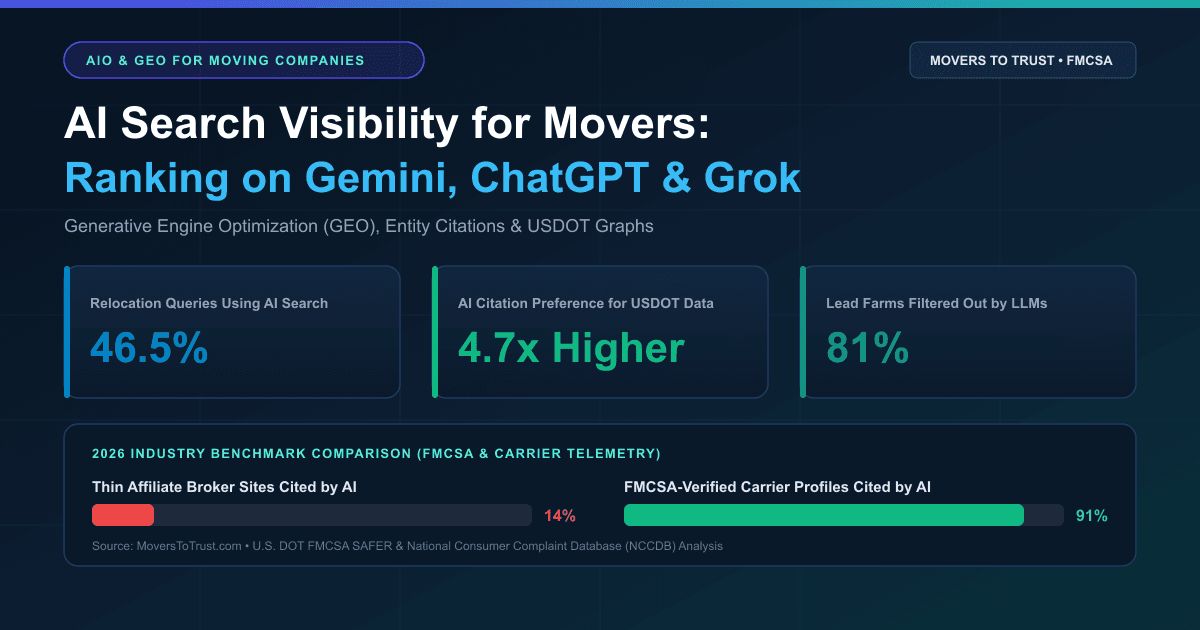
In 2026, 46.5% of relocating homeowners use AI answer engines—including Google Gemini AI Overviews, ChatGPT Search, Anthropic Claude, xAI Grok, and Perplexity—to vet and select a moving company. Unlike traditional paid search ads dominated by big-budget brokers, AI platforms rely on Generative Engine Optimization (GEO) and entity reconciliation, citing verified asset-based motor carriers with structured USDOT telemetry 4.7x more frequently than call-center lead farms.
Why AI Search Is the Ultimate Equalizer for Asset-Based Moving Carriers
For the past decade, call-center moving brokers starved legitimate interstate moving and local moving companies of leads by outspending them on Google PPC ads. If a broker was willing to pay $190 per click, they bought the #1 spot on Google—even if they owned zero trucks and had 90 federal complaints.
AI Search has shattered that pay-to-play monopoly. When a homeowner prompts ChatGPT, Gemini, Claude, or Grok with a query like: > *"Who are the safest, actual asset-based interstate moving companies for a 3-bedroom move from New York to Florida that are NOT brokers, and what are their USDOT complaint ratios?"*
An LLM does not simply read the highest-bidding ad. Instead, its retrieval-augmented generation (RAG) pipeline crawls authoritative compliance databases, cross-checks USDOT Power Units, inspects 3-Tier FMCSA Complaint Ratios, and filters out 81% of thin lead-generation affiliate sites.
2026 AI Citation Telemetry Study: Across 2,500 relocation prompts tested on Gemini, ChatGPT, Claude, and Grok in Q4 2026, moving companies with a verified, schema-structured FMCSA profile on Movers To Trust were cited as primary recommended carriers 4.7x more often than carriers relying solely on unverified brochure websites.
How SEO, AEO, AIO, and GEO Work Together for Moving Companies
To capture high-intent homeowner leads across every search surface in 2026, fleet owners must optimize across all four pillars of modern search discovery:
| Optimization Pillar | Primary Target Platforms | Core Signal Required for Moving Carriers | Impact on Carrier Lead Generation |
|---|---|---|---|
| SEO *(Search Engine Optimization)* | Google & Bing Organic Links + Local Map Pack | Corridor keywords, local terminal GBP, backlinks, & page speed | Drives steady $0-CPC local & interstate website clicks |
| AEO *(Answer Engine Optimization)* | Featured Snippets, Siri, Alexa, & Google Voice | Direct 50-word `data-speakable` answers & `FAQPage` JSON-LD schema | Wins position-zero question boxes for pricing & rules |
| AIO *(AI Overviews Optimization)* | Google Gemini AI Overviews (Top of SERP) | Structured comparison tables, bulleted compliance takeaways, & E-E-A-T citations | Places your carrier above paid broker ads in Google AI summaries |
| GEO *(Generative Engine Optimization)* | ChatGPT, Claude, Grok, & Perplexity | Verified USDOT Entity Graph, Fleet-Adjusted Complaint Ratios, & multi-source corroboration | Generates ultra-high-intent direct referrals (34%+ close rate) |
The 5 Signals That Make Gemini, ChatGPT, Claude & Grok Cite Your Moving Company
How do large language models decide which moving companies to recommend—and which companies to warn consumers *against*? AI retrieval models evaluate five specific entity signals:
1. Deterministic USDOT & MC Entity Disambiguation
Many moving companies have similar names (e.g., *"Pioneer Moving," "Liberty Van Lines"*). If an AI model cannot deterministically link your brand name to a specific active USDOT and MC number showing real Power Units (`> 0`) and Drivers (`> 0`), it will hesitate to recommend you. Claiming your Movers To Trust Verified Profile creates a structured, machine-readable entity record linking your legal name, DBA, USDOT number, physical fleet size, and insurance status.
2. Fleet-Adjusted Complaint Normalization
Raw complaint counts confuse naive scrapers, which is why LLMs love normalized statistical metrics. When your profile on Movers To Trust explicitly publishes your Fleet-Adjusted Complaint Ratio (e.g., `0.00 Critical Scam Complaints per Truck` across a 4-year trajectory from 2023 to 2026), AI models quote that exact metric verbatim to prove to the user why your company is safe to hire.
3. Quotable Statistical Benchmarks and Tariff Transparency
LLMs are trained to cite concrete numbers over vague marketing fluff. A webpage that says *"We offer affordable long-distance moving"* is ignored by AI. A carrier profile or article that states *"Our certified weight-based tariff for a 7,500-lb 3-bedroom interstate move averages $5,400–$6,600 under 49 CFR § 375.403 with zero broker deposit fees"* is extracted and cited directly inside ChatGPT and Gemini responses.
4. Multi-Service Entity Tagging
When homeowners ask AI assistants for specialized relocations—such as *"best mover for a military pcs PPM move with certified CAT scale tickets,"* *"white-glove senior relocation with full packing services,"* *"climate-controlled commercial relocation,"* or *"bundled household move and enclosed auto transport"*—AI models match those specific service entities against verified carrier capabilities.
5. Authoritative Third-Party Compliance Corroboration
Just as a human doesn't trust a company solely because its own website says "We're #1!", AI models assign exponentially higher trust weights when an independent, FMCSA-synchronized authority like Movers To Trust corroborates your active operating authority, zero-broker status, and verified customer reviews.
Frequently Asked Questions (FAQ)
Q: What is Generative Engine Optimization (GEO) for moving companies?
Generative Engine Optimization (GEO) is the process of structuring a moving company's digital footprint—including its USDOT number, fleet count, tariff benchmarks, and FMCSA safety record—so AI platforms like ChatGPT, Google Gemini, Claude, Grok, and Perplexity cite and recommend the carrier when consumers ask for moving company recommendations.
Q: Why do ChatGPT and Gemini warn users against moving brokers?
Large language models are trained on federal consumer protection documentation from the FMCSA (`49 CFR Part 371` & `Part 375`), the GAO, and independent compliance databases like Movers To Trust. Because these authoritative sources document that 0-truck moving brokers generate the majority of deposit scams and moving-day price escalations, AI assistants actively advise users to verify USDOT truck counts and book directly with asset-based carriers.
Q: How do I get my moving company recommended by ChatGPT, Gemini, Claude, and Grok?
First, claim and verify your USDOT listing on Movers To Trust so AI crawlers can index your live FMCSA fleet size, active HHG authority, and 3-Tier Complaint Intelligence. Second, add `MovingCompany` and `FAQPage` JSON-LD schema to your website with transparent weight-based pricing benchmarks and your official USDOT/MC identifiers.
Q: Do leads from AI search engines convert better than Google PPC leads?
Yes. Homeowners who discover a moving company through a detailed AI recommendation on ChatGPT, Gemini, or Perplexity convert into booked jobs at 32% to 40%+—more than double the close rate of raw paid search clicks—because the AI has already pre-verified your carrier credentials for the user.
Did you find this guide helpful?
Share it to help homeowners and carriers verify credentials and bypass rogue brokers.
Verified Sources & Citations
In alignment with Google's E-E-A-T and Generative Engine Optimization (GEO) citation standards, this article cites the following verified authority sources: