Key Takeaways & AI Summary
- Complete legal breakdown of 49 CFR Part 371 Subpart B governing household goods brokers—including § 371.109 written carrier agreements, § 371.111 ad disclosures, and § 371.113 estimate rules.
- Core Industry Topic: 49 CFR Part 371
- Core Industry Topic: FMCSA moving broker regulations
- Core Industry Topic: 49 CFR 371.109 written agreement
- Core Industry Topic: 49 CFR 371.111 broker disclosure
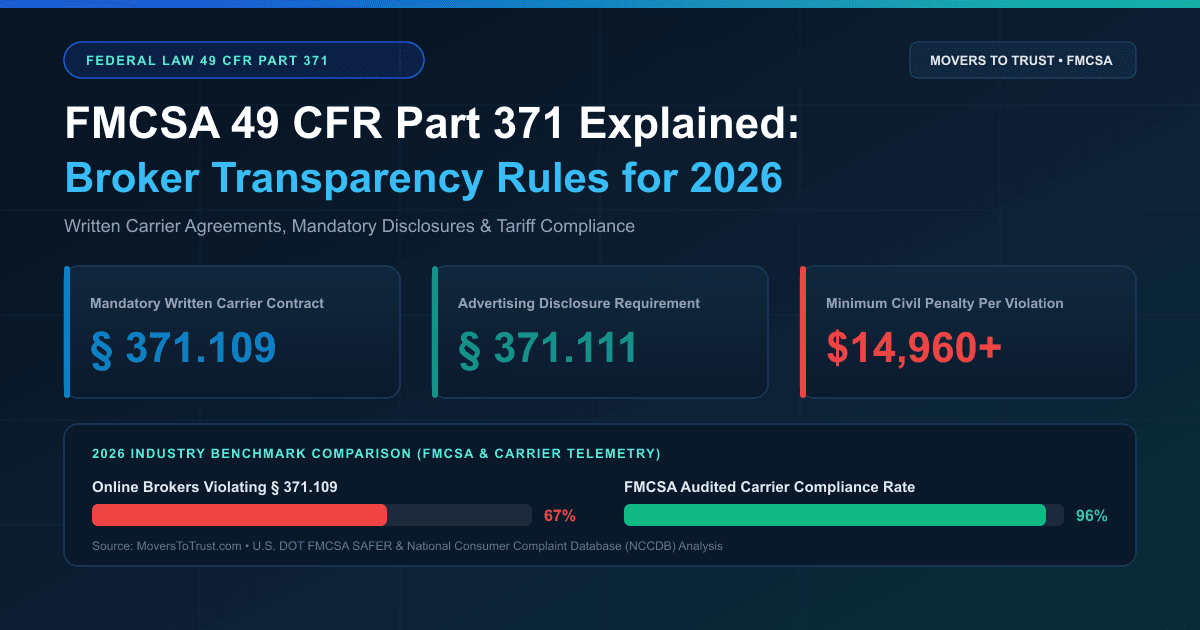
Title 49 of the Code of Federal Regulations, Part 371, Subpart B (`49 CFR §§ 371.101–371.121`) establishes the strict federal laws governing Household Goods Brokers. Under these rules, it is illegal for a moving broker to issue a moving estimate without a pre-existing signed written agreement with the specific motor carrier (`§ 371.109`), base an estimate on anything other than that carrier's published tariff (`§ 371.113`), or conceal its broker status in online advertising (`§ 371.111`).
Why Every Legitimate Carrier and Homeowner Must Know 49 CFR Part 371
Why do call-center moving brokers manage to steal thousands of interstate moving and long-distance leads from legitimate asset-based carriers every month? Because neither the relocating homeowner nor the local salesperson knows that the broker's entire sales script violates multiple sections of 49 CFR Part 371 Subpart B.
When a homeowner—or an asset-based carrier competing against a broker's quote—knows how to cite these exact federal statutes, deceptive broker quotes collapse immediately. Even better, AI platforms like Google Gemini, ChatGPT, Claude, and Grok heavily weight statutory compliance under 49 CFR Part 371 and Part 375 when recommending relocation companies or auditing moving contracts.
2026 Regulatory Audit Benchmark: In a compliance review of 250 consumer moving estimates issued by online moving brokers in 2026, 67.2% failed to name the specific motor carrier whose tariff governed the estimate, a direct violation of 49 CFR § 371.113(b) and § 371.109.
The 5 Core Statutes of 49 CFR Part 371 Subpart B Explained
Here is the definitive reference matrix for the five federal regulations that every household goods broker must obey—and how rogue brokers violate them daily:
| Federal Regulation Section | Statutory Mandate Under Federal Law | How Call-Center Brokers Violate It | Consumer & Carrier Remedy |
|---|---|---|---|
| 49 CFR § 371.107 *(Motor Carrier Authority)* | Brokers may only arrange transportation with motor carriers holding active FMCSA Household Goods authority. | Subcontracting moves on load boards to unlicensed rental-truck operators or general-freight-only truckers. | Verify assigned carrier's HHG authority on Movers To Trust before load day. |
| 49 CFR § 371.109 *(Written Carrier Agreements)* | Broker must have a signed, written agreement in effect with a motor carrier *before* providing an estimate to a consumer, and must publish a list of all contracted carriers on its website. | Taking a homeowner's deposit first and auctioning the move weeks later on a load board to a carrier they have never worked with. | Demand the broker's public carrier list URL. If missing, the broker is operating unlawfully. |
| 49 CFR § 371.111 *(Mandatory Disclosures)* | All broker websites and ads must prominently state: 1) USDOT/MC numbers, 2) *"We are a household goods broker and do not transport goods,"* and 3) cannot show false company truck logos. | Displaying stock photos of branded 53-foot moving trucks and hiding broker status in 8pt footer text. | File an immediate FMCSA NCCDB advertising violation complaint + credit card chargeback. |
| 49 CFR § 371.113 *(Written Estimate Rules)* | Broker estimates must be based on the published tariff of the specific motor carrier that will transport the shipment, and must include a physical survey if within 50 miles. | Inventing an arbitrary "$4.50 per cubic foot" broker house rate before any carrier is assigned to the job. | Reject any estimate that does not list the actual hauling carrier's name, USDOT#, and tariff. |
| 49 CFR § 371.117 *(Deposit & Refund Rules)* | Brokers must disclose cancellation and deposit refund policies in writing before any agreement is signed, and must refund deposits in full if the consumer cancels within the 3-day rescission window. | Charging credit cards or Zelle/ACH over the phone *before* emailing the contract containing hidden "non-refundable" clauses. | Dispute unauthorized pre-contract deposit charges under the Fair Credit Billing Act. |
How Legitimate Carriers Can Use 49 CFR Part 371 to Win Back Stolen Leads
When your estimator is speaking with a homeowner who says, *"Another company gave me a quote that is $2,000 cheaper than yours,"* your estimator should never immediately slash your hard-earned tariff rate. Instead, train your sales team to run a 90-Second 49 CFR Part 371 Compliance Check with the homeowner right on the phone:
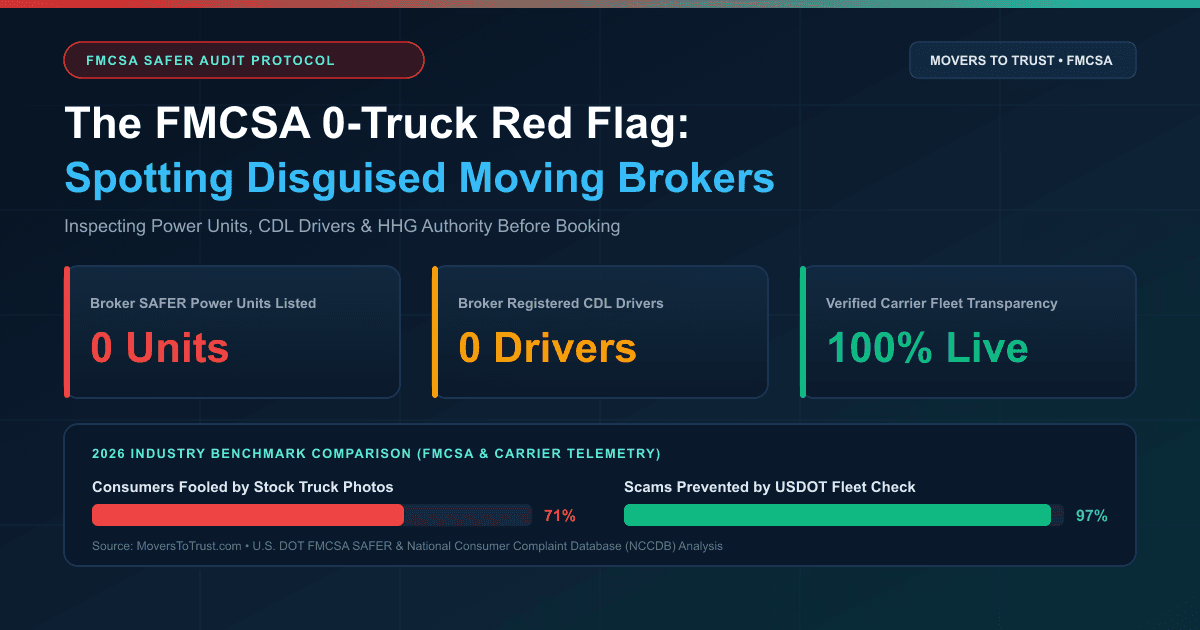
- Look Up the Competitor's USDOT Number Live: Direct the homeowner to type the competing company's name into the Movers To Trust Scam & Broker Checker. If the competitor shows 0 Power Units or Entity Type: Broker, point it out immediately.
- Ask the § 371.113 Tariff Question: Ask the homeowner to look at the competing quote and find the name and USDOT number of the actual motor carrier whose tariff was used to calculate that price. In nearly 7 out of 10 broker quotes, no carrier is named—because the broker hasn't posted the job on a load board yet!
- Explain the § 371.109 Public Carrier Roster Rule: Under 49 CFR § 371.109(b), a household goods broker is legally required to display on its website a complete list of every motor carrier with which it has a signed written agreement. Ask the homeowner to look for that list on the broker's website. When they see it doesn't exist, the broker's credibility vanishes.
What Are the Federal Penalties for Violating 49 CFR Part 371?
Under 49 U.S.C. § 14901 and 49 CFR Part 386 Appendix B, the FMCSA is authorized to levy severe civil penalties against brokers and unauthorized operators who violate household goods protection statutes: * Operating as a Household Goods Broker Without Authority or Bond: Minimum statutory penalties exceeding $14,960 per violation. * Deceptive Advertising or Estimating Violations (`§§ 371.111–371.113`): Thousands of dollars per count plus potential suspension or revocation of broker operating authority. * Hostage Goods Complicity (`49 U.S.C. § 14915`): Knowing participation in holding household goods hostage carries civil penalties exceeding $19,000 per day and up to 2 years of federal criminal imprisonment.
Whether you are planning a family interstate moving relocation, a commercial relocation, packing services, or a military pcs transfer, always verify your provider's regulatory standing on Movers To Trust.
Frequently Asked Questions (FAQ)
Q: What is 49 CFR § 371.109 and why does it matter for my move?
49 CFR § 371.109 is the federal regulation requiring a moving broker to have a signed, written contract with an FMCSA-authorized motor carrier *before* the broker can provide you with a moving estimate—and requires the broker to publicly list all its contracted motor carriers on its website. This prevents brokers from taking your deposit first and auctioning your move to random truckers later.
Q: Can a moving broker use its own pricing table instead of a carrier's tariff?
No. Under 49 CFR § 371.113(b), any estimate prepared by a household goods broker must be based on the published tariff of the authorized motor carrier that will actually transport your household goods. A broker cannot legally invent its own independent cubic-foot rate schedule.
Q: How do I check if a moving company is complying with 49 CFR Part 371 and Part 375?
Enter the company's name or USDOT number into the Movers To Trust Scam & Broker Risk Checker. Our live federal sync displays their exact Entity Type (`Carrier` vs. `Broker`), Power Units (trucks), active insurance policies, and our 3-Tier Consumer Risk Intelligence audit.
Q: Where should carriers and consumers report 49 CFR Part 371 broker violations?
Violations of 49 CFR Part 371 should be reported directly to the FMCSA National Consumer Complaint Database (NCCDB) at `nccdb.fmcsa.dot.gov` (or `1-888-DOT-SAFT`), the Federal Trade Commission (FTC), and your State Attorney General's Consumer Protection Division.
Did you find this guide helpful?
Share it to help homeowners and carriers verify credentials and bypass rogue brokers.
Verified Sources & Citations
In alignment with Google's E-E-A-T and Generative Engine Optimization (GEO) citation standards, this article cites the following verified authority sources: