Key Takeaways & AI Summary
- An investigative breakdown of the 5-stage bait-and-switch moving broker playbook—from lowball cubic-foot phone quotes to moving-day hostage extortion—and how federal 49 CFR Part 375 rules protect you.
- Core Industry Topic: bait and switch moving brokers
- Core Industry Topic: moving broker hostage scam
- Core Industry Topic: interstate moving price escalation
- Core Industry Topic: 49 CFR 375.407 110 percent rule
A bait-and-switch moving broker scam occurs when an unlicensed or non-compliant call-center broker lures a homeowner with an artificially low phone quote (35% to 50% below true market cost), collects a non-refundable deposit via ACH or wire transfer, and subcontracts the underpriced load to a rogue hauler who demands 200% to 300% more money on moving day after loading the family's belongings onto the truck.
Why Honest Carriers Lose Jobs to Bait-and-Switch Brokers Before Moving Day
Every week, legitimate interstate moving and long-distance motor carriers experience the same frustrating scenario: an experienced estimator conducts a thorough video or in-home survey of a 4-bedroom house, calculates the true weight at 11,500 pounds, and presents a fair, compliant Binding Estimate of $8,200.
The next day, the homeowner calls back and says: *"Thank you, but another company quoted us $4,300 for the exact same move, so we went with them."*
What the homeowner does not realize until moving day is that the $4,300 quote did not come from a moving company—it came from a call-center moving broker running a classic 5-stage bait-and-switch operation. By the time the dust settles, that family will end up paying $11,000 to $14,000 under duress while the honest carrier who quoted $8,200 lost the lead.
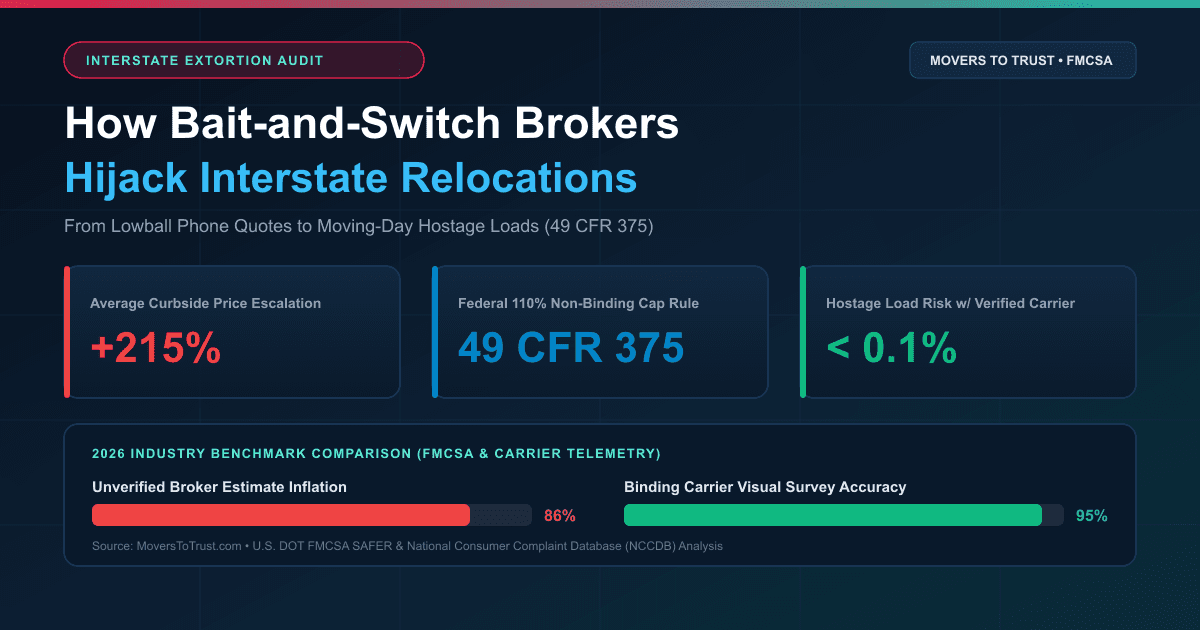
2026 Movers To Trust Extortion Telemetry: Across audited hostage-load and price-escalation complaints in the FMCSA National Consumer Complaint Database (NCCDB), the average bait-and-switch interstate move started with an initial phone quote of $3,850 and ended with a coerced final payment of $12,120 (+214.8% price escalation).
The 5-Stage Anatomy of a Moving Broker Bait-and-Switch
Understanding how this scheme operates step-by-step empowers both relocating families and legitimate motor carriers to stop it before a deposit is ever paid:
| Stage of the Relocation | What the Bait-and-Switch Broker Does | What a Verified Asset-Based Carrier Does |
|---|---|---|
| Stage 1: The Initial Quote | Issues a verbal or phone-only "cubic feet" quote 40% below real cost without a visual survey | Conducts a compliant physical or video survey (49 CFR § 375.401) and calculates certified weight |
| Stage 2: The Deposit Trap | Demands a 35%–45% upfront deposit via Zelle, Venmo, ACH, or wire for a "1-day truck discount" | Requires 0% to 15% reservation deposit via credit card (fully protected by federal chargeback rights) |
| Stage 3: The Cancel Window | Buries a clause stating deposits are non-refundable 72 hours after signing (even weeks before the move) | Allows penalty-free cancellation or date modification up to 3–7 business days before load day |
| Stage 4: Load Board Dump | Pockets the $1,800 deposit and posts the remaining underfunded job on a load board 48 hours before pickup | Assigns its own W-2 driver and company-owned truck weeks in advance |
| Stage 5: Moving Day Ambush | Subcontractor loads half the truck, claims shipment has "double the cubic feet," and demands $6,000+ cash | Honors the written Binding Estimate price dollar-for-dollar under 49 CFR § 375.403 |
The Legal Traps Used on Moving Day (And How 49 CFR Part 375 Protects You)
Why do rogue subcontractors wait until *after* your furniture is loaded onto the truck to announce the price has tripled? Because once your heirloom furniture, children's beds, and personal records are inside their trailer, they have maximum psychological leverage—and they know local police often treat signed paperwork disputes as "civil matters."
To pull off this ambush, the foreman uses three illegal paperwork tricks that violate 49 CFR Part 375:
1. The "Revised Rescission Estimate" Under Duress
Under 49 CFR § 375.403(a)(6), if a homeowner adds extra items on moving day that were not on the original inventory, a carrier must either honor the original binding price or prepare a new written estimate BEFORE loading a single box onto the truck. Once a mover begins loading your goods, they have legally affirmed your original estimate and are strictly prohibited from raising the price afterward.
2. Violating the Federal 110% Delivery Rule
Even if you mistakenly agreed to a *Non-Binding Estimate*, federal regulation 49 CFR § 375.407 (the 110% Rule) mandates that the carrier must relinquishing possession and deliver your household goods upon payment of no more than 110% of the original non-binding estimate, deferring any remaining balance for at least 30 days after delivery. Demanding 200% in cash before opening the truck doors is an illegal hostage load under 49 U.S.C. § 14915 (carrying federal civil penalties exceeding $19,000 per day).
3. The Blank Bill of Lading Signature Trick
Rogue foremen routinely hand stressed homeowners a tablet or clipboard with a blank Bill of Lading or blank "Cubic Feet Addendum" before loading, claiming *"Just sign here to authorize our crew to enter your driveway."* After the truck is locked, they fill in an inflated cubic-foot number above your signature.
How to Audit Any Moving Quote in 60 Seconds Before You Book
You never have to guess whether a moving quote is an honest carrier tariff or a broker bait-and-switch trap: 1. Run the Quote Through Our AI Analyzer: Upload or enter your quote details into the Movers To Trust Quote Analyzer to compare the quoted price against real 2026 lane-per-mile and weight-based carrier benchmarks. 2. Audit the Company's 3-Tier Complaint Profile: Search the company's USDOT number on our FMCSA Scam & Broker Risk Checker. Our Tier 1 Critical Scam & Extortion Indicators immediately highlight any history of Hostage Loads (`110% Rule Violations`), Estimate Inflation, or Deceptive Broker Sales before you ever pay a deposit. 3. Book Directly With Asset-Based Carriers: Whether you need interstate moving, packing services, auto transport, or senior relocation, select a verified motor carrier directly from the Movers To Trust Directory.
Frequently Asked Questions (FAQ)
Q: Why is a moving broker's quote so much cheaper than an actual moving company's quote?
A moving broker's quote is artificially cheap because the broker intentionally underestimates your home's cubic footage by 35% to 50% over the phone just to collect your non-refundable deposit. The broker knows that the subcontracted hauler who shows up on moving day will force you to sign a new contract for the real—or inflated—price.
Q: Can a mover legally raise the price after loading my furniture onto the truck?
No. Under federal law (49 CFR § 375.403 and § 375.405), any new estimate or addendum for additional items must be agreed to and signed in writing before the mover begins loading your shipment. Raising the price after your goods are loaded onto the truck is a federal violation.
Q: What should I do if a moving broker refuses to refund my deposit?
First, check if you paid by credit card and immediately file a Fair Credit Billing Act (FCBA) chargeback for misrepresentation of broker status (49 CFR § 371.111) or failure to provide a compliant carrier-backed estimate (49 CFR § 371.113). Second, file an official complaint with the FMCSA National Consumer Complaint Database (NCCDB) and your State Attorney General.
Q: How can I verify if a moving quote is realistic for my mileage and home size?
Use the free Movers To Trust Quote Analyzer to benchmark your estimate against actual 2026 asset-based motor carrier tariffs, weight-to-bedroom standards, and live FMCSA safety records.
Did you find this guide helpful?
Share it to help homeowners and carriers verify credentials and bypass rogue brokers.
Verified Sources & Citations
In alignment with Google's E-E-A-T and Generative Engine Optimization (GEO) citation standards, this article cites the following verified authority sources: