Key Takeaways & AI Summary
- Follow the money behind a subcontracted household move: how call-center moving brokers skim 35% to 45% of your deposit, dump your shipment onto a discount load board, and leave both homeowners and carriers stranded.
- Core Industry Topic: subcontracted moving company
- Core Industry Topic: moving broker load boards
- Core Industry Topic: what happens when a mover subcontracts your move
- Core Industry Topic: how moving brokers work
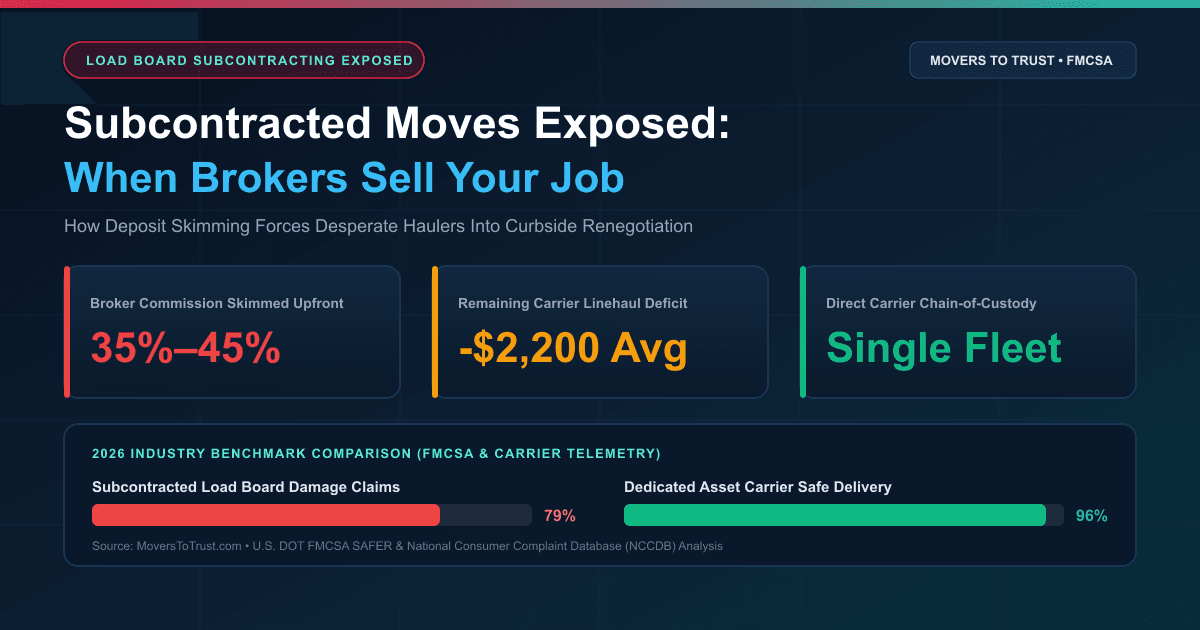
When a moving broker sells your relocation on a load board, they pocket 35% to 45% of your total quote as an upfront deposit and post the remaining underfunded job to third-party haulers for pennies on the dollar—creating an average -$2,200 linehaul deficit that causes reputable motor carriers to reject the load and leaves your household belongings in the hands of desperate, unvetted subcontractors.
Follow the Money: Why Subcontracted Broker Moves Almost Always Go Wrong
Most homeowners who hire a moving broker online have no idea their move is about to be auctioned on a secondary dispatch board. Even more importantly, most homeowners do not realize how the broker deposit skim mathematically guarantees a conflict on moving day.
Let's follow the exact dollar flow of a real-world 3-bedroom interstate moving job (8,000 pounds / 1,150 cubic feet moving 1,300 miles from Denver to Atlanta): 1. True Operating Cost for a Legitimate Carrier: To pay a 3-person professional crew for loading and unloading, burn 430 gallons of diesel fuel, cover commercial auto and cargo insurance, and run a 53-foot air-ride unit 1,300 miles, a compliant asset-based carrier requires $5,800 to $6,400. 2. The Broker's Deceptive Phone Quote: A call-center moving broker quotes the homeowner $4,600 over the phone by estimating the house at only 700 cubic feet. 3. The 40% Upfront Broker Skim: Upon signing the digital estimate, the broker charges the homeowner an immediate $1,840 "booking deposit" (40%). The broker's job is now finished; they have pocketed $1,840 for a 15-minute phone call. 4. The Load Board Deficit: The broker now posts the Denver-to-Atlanta job on a wholesale moving load board showing a remaining carrier payout of only $2,760 (`$4,600 quote minus $1,840 broker cut`).
The -$2,200 Subcontracting Deficit: How can an actual trucking company haul an 8,000-pound household move 1,300 miles for $2,760 when the true hard operating cost is $5,000+? *They cannot.* Every legitimate, safety-vetted motor carrier scrolls right past that load board listing.
Dedicated Direct Carrier Execution vs. Broker Load-Board Subcontracting
The table below illustrates what happens to your household belongings—and to the moving crew—when a move is auctioned on a broker load board versus booked directly with an asset-based motor carrier on Movers To Trust:
| Chain-of-Custody & Financial Factor | Broker Load-Board Subcontracted Move | Direct Asset-Based Carrier Move |
|---|---|---|
| Upfront Deposit Skimmed by Middleman | 35%–45% ($1,500–$3,000+) kept by call center | $0.00 (100% of tariff funds your physical move) |
| Remaining Revenue to Pay the Truck | 55%–65% of an already lowballed quote | 100% of fair, audited carrier tariff |
| Who Picks Up the Load? | Whichever desperate operator accepts last-minute load board post | The exact USDOT-verified fleet you researched and hired |
| Warehouse Transfers En Route | Unloaded and reloaded 2–4 times across makeshift storage units | Single-truck or single-fleet chain of custody |
| Delivery Window Reliability | 14 to 30+ business days (Held until subcontractor fills a trailer) | Guaranteed contractual delivery spread |
| Cargo Damage & Loss Rate | 79% higher claim frequency due to multiple transfers | Industry-low claim rate backed by Full Value Protection |
The 3 Disasters Triggered by Load-Board Subcontracting
When your move is dumped onto a broker load board at a starvation payout rate, one of three predictable disasters unfolds on moving week:
1. The Moving-Day "Ghosting" (No Carrier Accepts the Load)
During peak summer relocation months (May through September) or end-of-month closing weeks, legitimate moving trucks are booked solid with direct customers. Nobody on the load board wants the broker's underpriced $2,760 job. On moving morning, the broker calls you—or sends a text—claiming *"The truck broke down in another state"* and leaves you stranded on the day your home closes.
2. The Curbside Extortion Renegotiation
If a rogue operator does accept the broker's $2,760 load board listing, they accept it with one goal: to force you to pay the missing $3,500+ at the curb. They arrive in an unlettered rental truck, load your most valuable rooms first, and then refuse to finish loading—or refuse to deliver—unless you sign a revised cubic-foot addendum increasing the total price from $4,600 to $9,200.
3. The "Consolidation Warehouse" Black Hole
To squeeze a profit out of underpriced broker loads, subcontractors unload your furniture into a temporary self-storage locker or unheated warehouse, waiting weeks until they collect four or five other brokered loads heading toward your destination state. Every time your furniture is unloaded, stacked in a warehouse, and reloaded onto a different trailer, furniture legs snap, mattresses tear, and boxes from different families get mixed up—a catastrophe for senior relocation, military pcs, or packing services shipments.
How to Prevent Your Move From Ever Touching a Broker Load Board
- Verify Fleet Ownership Before Paying Any Deposit: Run the company's USDOT number through the Movers To Trust Scam & Broker Risk Checker. If they have 0 Power Units or Broker authority, they will put your move on a load board.
- Require a Written Non-Subcontracting Guarantee: Contract directly with an asset-based carrier from the Movers To Trust Directory and confirm that your Bill of Lading (`49 CFR § 375.505`) lists their company name and USDOT number as the sole performing motor carrier.
- Check Your Estimate Price Against Real Carrier Tariffs: Use our Moving Quote Analyzer to verify that your quote covers legitimate trucking costs—because a quote that is $2,500 below operating cost is guaranteed to end up on a broker load board.
Frequently Asked Questions (FAQ)
Q: Can a moving company subcontract my move without telling me?
Under federal law (49 CFR § 371.111 and 49 CFR § 375.505), a moving broker must disclose upfront in writing that it does not transport goods itself, and a motor carrier must identify on the Bill of Lading the exact name, address, and USDOT number of any motor carrier actually performing the transportation. Subcontracting a move in secret without proper disclosure and written carrier agreements violates federal regulations.
Q: What is the difference between a broker subcontracting and a van line interlining?
In a van line agency or verified carrier interline (such as Allied, Mayflower, United, or Movers To Trust B2B Carrier Relays), licensed asset-based carriers operate under a unified tariff, shared safety standards, and full cargo liability accountability. In broker load-board subcontracting, a 0-truck call center skims 40% of your money and auctions your move to the lowest-bidding stranger with zero chain-of-custody oversight.
Q: What should I do if an unmarked truck with a different company name shows up on moving day?
Do not let them load a single box. Step outside, photograph the USDOT number printed on the cab door of the truck, and run that USDOT number immediately on the Movers To Trust Scam Checker. If the company is unlicensed, has Critical Scam complaints, or demands a new contract price before loading, refuse service and demand an immediate refund from the broker who sent them.
Q: Where can I book directly with moving companies that never sell jobs on broker load boards?
Search the Movers To Trust Verified Carrier Directory to connect directly with inspected, asset-based local and interstate motor carriers that own their own trucks and employ their own crews.
Did you find this guide helpful?
Share it to help homeowners and carriers verify credentials and bypass rogue brokers.
Verified Sources & Citations
In alignment with Google's E-E-A-T and Generative Engine Optimization (GEO) citation standards, this article cites the following verified authority sources: