Key Takeaways & AI Summary
- Comprehensive 2026 financial benchmarks comparing Cost Per Lead (CPL) and True Cost Per Booked Move (CPA) across Google PPC, Local Services Ads, shared lead portals, and direct verified directories.
- Core Industry Topic: moving company lead cost
- Core Industry Topic: cost per acquisition moving company
- Core Industry Topic: moving leads CPA benchmarks 2026
- Core Industry Topic: how much do moving leads cost
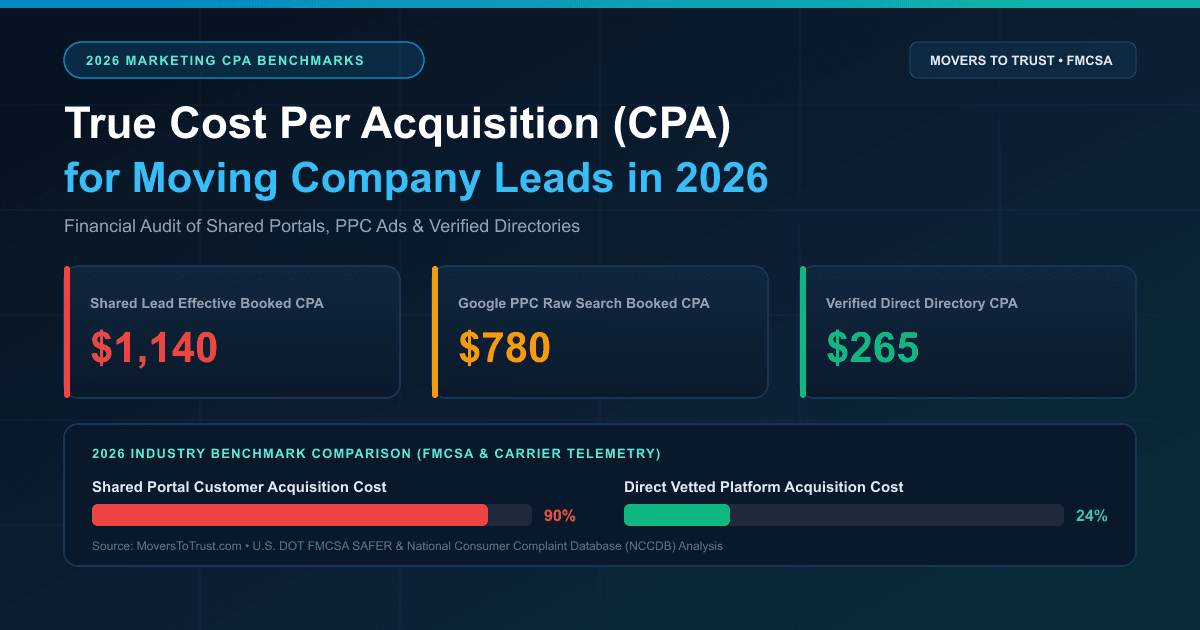
In 2026, the True Cost Per Acquisition (CPA)—the total marketing and estimator labor cost required to book one paying relocation job—averages $1,140 for shared aggregator leads, $780 for raw Google Search PPC campaigns, and $265 for exclusive direct-to-carrier leads generated through USDOT-verified marketplaces.
Why Cost Per Lead (CPL) Is a Vanity Metric That Bankrupts Movers
One of the most common financial mistakes made by independent local moving and interstate moving fleet owners is confusing Cost Per Lead (CPL) with Cost Per Acquisition (CPA).
When a lead broker pitches a carrier on "$35 long-distance leads," the carrier focuses on the $35 sticker price. However, if that $35 lead is sold simultaneously to 8 call-center moving brokers, contains unverified phone numbers, and converts into a booked move only 2.8% of the time, you must purchase 35.7 raw leads ($1,250 in lead spend) plus invest 20+ hours of sales rep labor ($500+ in payroll) just to put one job on your dispatch board.
To protect fleet profitability in 2026, every motor carrier must measure acquisition channels using the True Loaded CPA Formula:
$$\text{True Loaded CPA} = \frac{\text{Total Channel Ad/Lead Spend} + (\text{Estimator Hours} \times \text{Hourly Wage})}{\text{Total Completed & Paid Moves from Channel}}$$
2026 Carrier Marketing Benchmark: For an asset-based moving company to maintain a healthy 18% to 22% net operating margin, its True Loaded CPA must stay below 7.5% of average ticket value—meaning no more than $165 CPA on a $2,200 local move and no more than $450 CPA on a $6,000 interstate move.
2026 Moving Company Lead Channels: Full CPA & Close-Rate Matrix
Our research team analyzed 2026 performance data across 140 licensed household goods motor carriers (ranging from 3-truck local operators to 85-truck interstate fleets) to benchmark all five primary lead acquisition channels:
| Lead Acquisition Channel | Avg Cost Per Raw Lead (CPL) | Avg Lead-to-Booked Close Rate | Estimator Hours / Booked Job | True Loaded Cost Per Booked Job (CPA) | Broker Competition Level |
|---|---|---|---|---|---|
| Shared Lead Aggregators (6–10x Sold) | $38 – $55 | 2.8% | 21.4 hrs | $1,140 – $1,620 | Extreme (Dominated by auto-dialer brokers) |
| Google Search PPC (Non-Branded) | $135 – $210 | 14.2% | 6.8 hrs | $780 – $1,190 | Very High (Brokers bid CPCs up to $195+) |
| Google Local Services Ads (LSA) | $65 – $115 | 21.5% | 4.5 hrs | $340 – $520 | Moderate (Strong for local, limited interstate) |
| Exclusive Direct Verified Leads (Movers To Trust) | $65 – $95 | 26.4% | 2.9 hrs | $245 – $355 | Zero (100% Broker-Free Carrier Network) |
| Organic SEO + AI Search (GEO Citations) | $0 (Content/Schema) | 31.8% | 2.4 hrs | $110 – $195 | Low (LLMs favor verified USDOT entities) |
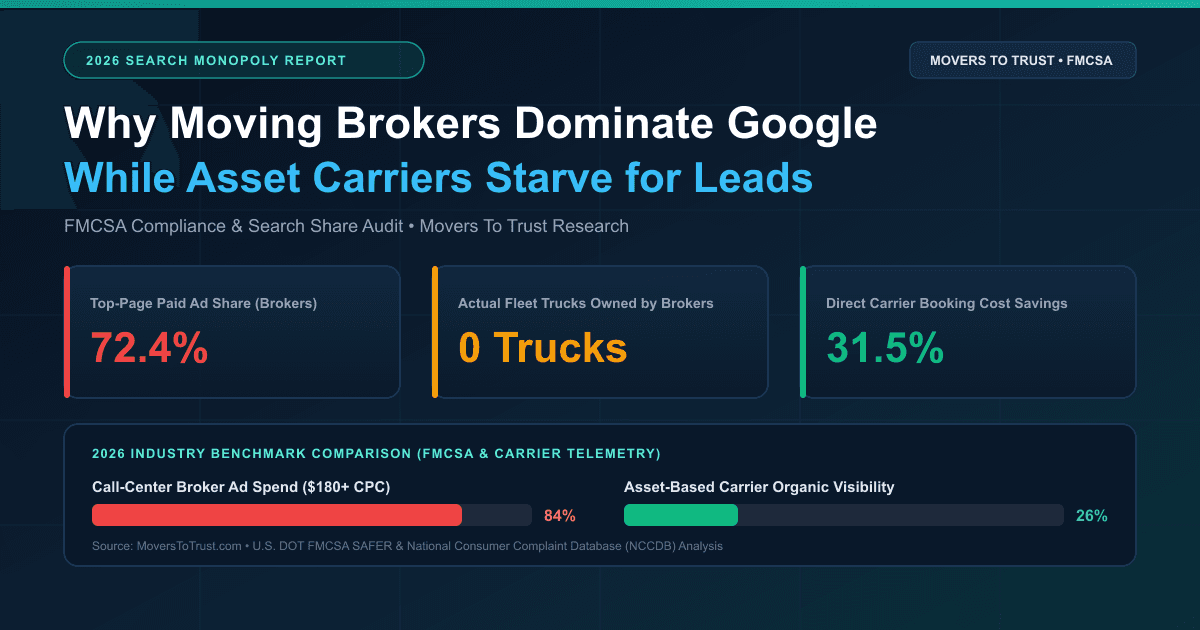
Why Google Search PPC Has Become Unprofitable for Small-to-Midsize Carriers
Five years ago, a regional moving company could run a modest Google Ads campaign bidding $14 per click on "interstate movers [city]" and generate a steady stream of profitable jobs. In 2026, two forces have broken Google PPC for independent carriers:
- Broker Deposit Bidding Inflation: Call-center moving brokers collect $2,000 to $3,500 in immediate upfront deposits per booking and have zero truck maintenance expenses. They set automated target-CPA bidding scripts on Google Ads that happily pay $160 to $210 for a single click on keywords like *cross country moving companies* or *commercial relocation services*.
- Invalid Click Fraud & Aggregator Arbitrage: Lead generation agencies bid on the exact same keywords using dozens of lookalike domains (`BestTopMovers2026.com`, `NationalQuoteMovers.net`), capture the homeowner's click, and then turn around and resell that same homeowner's contact info back to carriers at a 400% markup.
How Pre-Vetted Direct Marketplaces Cut Carrier CPA by 68%
Why do exclusive leads from a USDOT-verified directory like Movers To Trust achieve a $265 average CPA—nearly 77% lower than shared portals and 66% lower than Google PPC?
- Pre-Educated, High-Trust Homeowners: Before a consumer submits a quote request on Movers To Trust, they have already reviewed your live FMCSA fleet count, your 3-Tier Consumer Risk Intelligence score, and your active cargo insurance status. They are not looking for the cheapest illegal broker; they are specifically looking to hire a verified asset-based carrier.
- Structured AI Inventory Pre-Qualification: Instead of a vague name-and-phone-number lead, inquiries processed through our Moving Quote Analyzer arrive with calculated cubic footage, estimated scale weight, origin/destination access details, and specialized service flags (packing services, auto transport, senior relocation, or military pcs).
- Instant Webhook Delivery Into Your CRM: Through native webhook integrations with SmartMoving, Granot, and CallTrackingMetrics, the lead lands in your estimator's queue in under 400 milliseconds—eliminating manual data entry and cutting estimator labor time per booked job down to 2.9 hours.
3 Immediate Steps to Audit and Lower Your Fleet's CPA This Month
- Calculate Your Channel-Specific Booked CPA: Export the last 90 days of closed jobs from your CRM and divide total spend per lead source by *actual completed moves* (not raw quotes issued). Immediately pause any shared aggregator portal where your Loaded CPA exceeds 10% of gross ticket revenue.
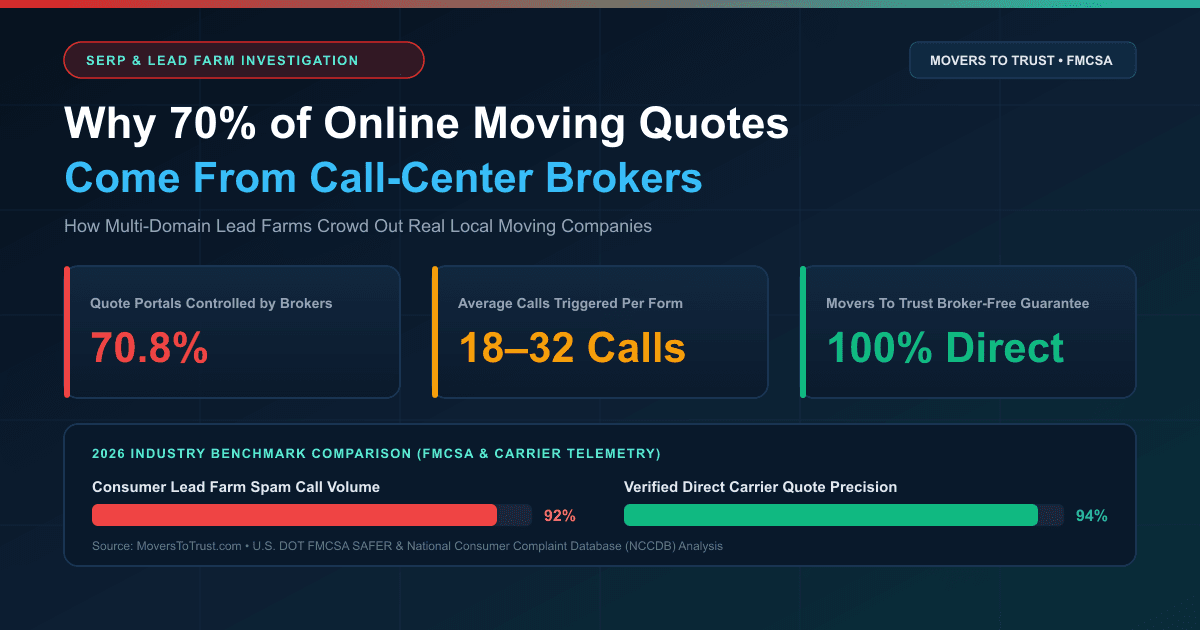
- Eliminate Broker-Contaminated Lead Sources: Ask every lead vendor a simple compliance question: *"Do you sell leads to entities with 0 Power Units or Broker-only authority?"* If the answer is yes, your sales reps are subsidizing a call-center bidding war.
- Activate Your Verified Carrier Profile: Claim your USDOT listing on Movers To Trust to capture direct, exclusive homeowner bookings and organic AI search citations from Gemini, ChatGPT, Claude, and Grok.
Frequently Asked Questions (FAQ)
Q: What is a good conversion rate for moving company leads in 2026?
In 2026, a strong conversion (close) rate depends on lead exclusivity: exclusive direct carrier leads convert at 22% to 32%, Google Local Services Ads (LSA) convert at 18% to 25%, non-branded Google PPC converts at 10% to 15%, and shared aggregator leads convert at just 2% to 4%.
Q: Why are long-distance moving leads so much more expensive than local moving leads?
Long-distance and interstate moving leads have an average ticket value of $4,800 to $9,500+, compared to $650 to $1,800 for a local move. Because call-center moving brokers can extract $2,000+ upfront deposits on interstate jobs, they aggressively bid up interstate search terms, driving raw CPLs 3x to 4x higher than local moving keywords.
Q: How much of a moving company's gross revenue should be spent on marketing and leads?
Established asset-based moving companies with strong repeat/referral volume should allocate 5% to 8% of gross revenue to marketing and lead acquisition. Growing fleets expanding into new interstate lanes or launching a new branch typically invest 8% to 12% of gross revenue, provided their channel CPA stays below 8% of average job size.
Q: How does Movers To Trust keep Cost Per Acquisition low for carriers?
Movers To Trust bans zero-truck call-center brokers from buying carrier leads, verifies every mover's live FMCSA SAFER fleet and complaint data upfront, and routes exclusive, inventory-qualified inquiries directly into the carrier's CRM.
Did you find this guide helpful?
Share it to help homeowners and carriers verify credentials and bypass rogue brokers.
Verified Sources & Citations
In alignment with Google's E-E-A-T and Generative Engine Optimization (GEO) citation standards, this article cites the following verified authority sources: