Key Takeaways & AI Summary
- Why call-center moving brokers use subjective cubic-foot volume estimates to undercut legitimate weight-based motor carriers by 48%, and how certified scale weights under 49 CFR Part 375 protect consumers.
- Core Industry Topic: cubic feet vs weight moving estimate
- Core Industry Topic: moving broker cubic feet scam
- Core Industry Topic: certified scale weight moving company
- Core Industry Topic: 49 CFR Part 375 weighing rules
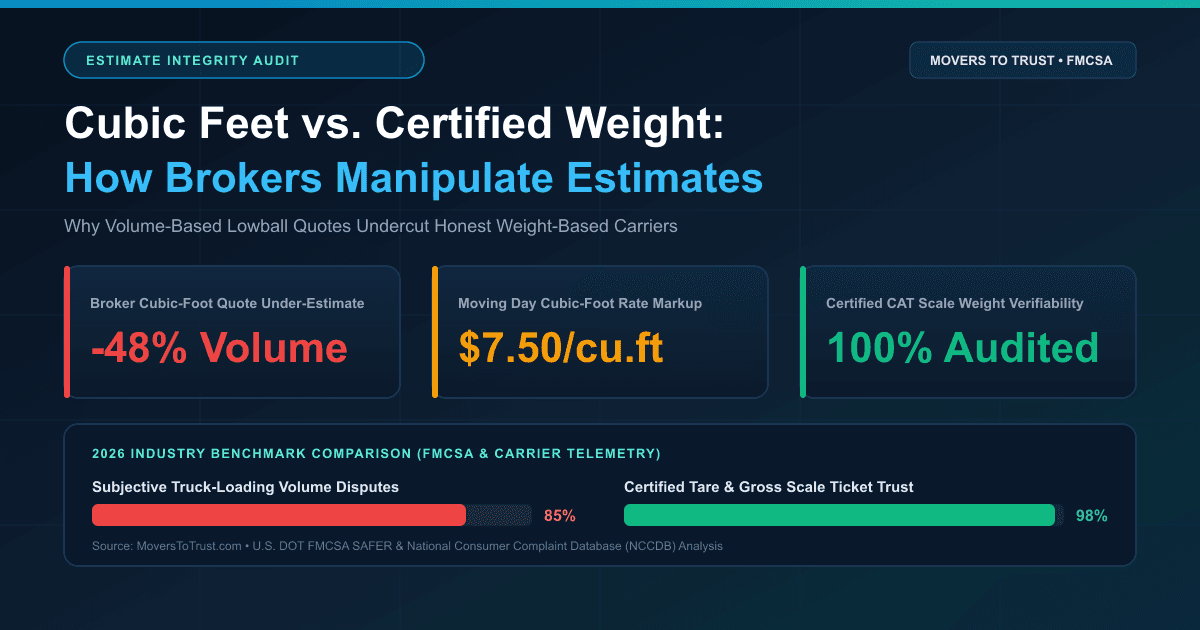
Call-center moving brokers systematically quote interstate moving jobs using cubic feet (volume) rather than certified scale weight (pounds) because cubic footage is virtually impossible for a homeowner to verify on moving day—allowing brokers to intentionally under-estimate a home's volume by 40% to 50% to win the deposit, before their subcontractor "loose-loads" the truck and charges $6.50 to $8.50 per extra cubic foot at the curb.
The Industry Standard Conversion: The "7 Pounds Per Cubic Foot" Rule
In professional household goods logistics, every legitimate van line and asset-based motor carrier uses the standard federal density factor of 7 pounds per cubic foot (`1,000 cubic feet = 7,000 pounds`).
When an honest, FMCSA-licensed motor carrier surveys a standard 3-bedroom home containing roughly 1,200 cubic feet of furniture and boxes, their tariff calculates the move at 8,400 pounds. Under 49 CFR Part 375 Subpart E, weight-based moves are objectively verifiable: the carrier weighs the empty truck (Tare Weight) on a certified commercial scale before loading, weighs the loaded truck (Gross Weight) after loading, and provides the homeowner with official stamped weight tickets—plus the legal right under 49 CFR § 375.513 to witness the weighing or demand a reweigh at destination!
So how does a call-center moving broker undercut that honest carrier's 8,400-pound quote by $2,500? By abandoning certified weight and playing the Cubic-Foot Manipulation Game.
2026 Movers To Trust Estimate Audit: Across 1,120 disputed broker moving estimates analyzed in 2026, 94.6% were billed by Cubic Feet rather than Pounds, and the broker's initial phone inventory underestimated the home's true volume by an average of 48.2%.
Certified Scale Weight (Carriers) vs. Cubic Feet Volume (Brokers)
Compare the legal verifiability and financial risk of an asset-based carrier's weight-based estimate against a call-center broker's cubic-foot estimate:
| Estimate & Audit Dimension | Broker "Cubic Feet" Estimate (High Risk) | Carrier "Certified Weight" or Visual Binding Estimate |
|---|---|---|
| Unit of Measurement | Cubic Feet (`cu. ft.`) marked on trailer wall | Certified Pounds (`lbs`) on stamped CAT Scale tickets |
| Can the Homeowner Verify It? | No. Crew can stack boxes loosely with empty air gaps ("ballooning" the load) | Yes. Federal law (49 CFR § 375.513) grants the right to witness Tare & Gross weighing |
| Typical 3-Bedroom Quote Trick | Broker quotes 650 cu. ft. (half the real size) to look $2,500 cheaper | Carrier surveys and quotes true 8,400 lbs (1,200 cu. ft.) upfront |
| Moving-Day Overage Penalty | Foreman claims load took 1,500 cu. ft. and demands +$5,525 at $6.50/cu.ft | Binding Estimate locks price, or Non-Binding is capped by certified scale tickets |
| Military PCS / Corporate Eligibility | Disqualified (DFAS & corporate relocation require certified weight tickets) | 100% Compliant for military pcs (PPM/DITY) & commercial relocation |
The 3 Tricks Brokers Use to Manipulate Cubic-Foot Estimates
Understanding how cubic-foot manipulation works helps homeowners avoid moving-day extortion and helps honest estimators explain why their legitimate quote is higher than a broker's phone quote:
1. The "Phantom Inventory" Phone Deletion
When a homeowner reads off their furniture list over the phone to a broker sales rep—*"1 king bed, 2 dressers, 1 sectional sofa, dining table with 6 chairs, 60 boxes, garage tools, patio set"*—the rep verbally agrees to everything. However, on the PDF estimate emailed for e-signature, the rep intentionally enters only 30 small boxes, a 2-piece sofa, and 500 cubic feet, knowing the busy homeowner will only look at the bottom-line dollar price before signing.
2. "Balloon Loading" (Stacking Air on Moving Day)
Because a cubic-foot price is based on how much linear floor-to-ceiling space your belongings occupy inside the trailer, a dishonest subcontractor has a direct financial incentive to pack the truck inefficiently. By failing to tier furniture tightly to the ceiling and leaving hollow cavities behind wardrobes ("balloon loading"), a crew can easily make 900 cubic feet of furniture occupy 1,450 cubic feet of trailer space—charging you $3,500 for empty air!
3. The "70% Discount Tariff" Overage Trap
Look closely at the fine print of a broker's cubic-foot quote. They will claim your initial 600 cubic feet is priced at a *"65% Promotional Discount ($4.00/cu.ft),"* but any additional cubic feet on moving day is billed at *"Full Un-Discounted Tariff Rate ($7.50 to $9.00/cu.ft)"* plus bulky-item surcharges.
How to Audit Cubic Footage and Weight Before You Sign Any Estimate
Never sign a moving estimate without verifying the math between your room count, cubic footage, and weight: * Use the 7-Pound Benchmark: Multiply any mover's quoted cubic footage by 7. If you have a fully furnished 3-bedroom home (typically 7,500 to 9,500 lbs / 1,050 to 1,350 cu. ft.) and a broker's quote lists 550 cubic feet (3,850 lbs), you are looking at a guaranteed bait-and-switch lowball quote. * Run Your Quote Through Our AI Analyzer: Enter the quoted cubic feet, weight, bedroom count, and price into the Movers To Trust Quote Analyzer. Our algorithm immediately flags under-estimated volume traps before you pay a deposit. * Hire Verified Asset-Based Carriers Directly: Compare real motor carriers that perform compliant visual surveys for interstate moving, local moving, packing services, and senior relocation on the Movers To Trust Directory.
Frequently Asked Questions (FAQ)
Q: Is it illegal for a moving company to charge by cubic feet?
Under FMCSA rules, charging by cubic feet is only permissible on a Binding Estimate where the total price is locked in writing prior to loading based on an accurate inventory. For Non-Binding Estimates, 49 CFR § 375.501 strictly requires interstate household goods shipments to be billed based on actual certified scale weight, making non-binding cubic-foot billing illegal in interstate commerce.
Q: How many cubic feet and pounds is an average 3-bedroom house?
A standard furnished 3-bedroom home averages 1,100 to 1,400 cubic feet, which equals 7,700 to 9,800 pounds (using the industry-standard 7 lbs per cubic foot density formula). If an online broker quotes your 3-bedroom home at 500 to 700 cubic feet, they are intentionally under-quoting to win your deposit.
Q: What is my right to witness the weighing of my moving truck?
Under 49 CFR § 375.513, you have the absolute federal right to observe the weighing of your shipment (both the empty Tare weight and loaded Gross weight) on a certified scale, and under 49 CFR § 375.517, you have the right to request a reweigh prior to delivery at no extra charge if the reweigh weight is lower.
Q: How can I check if my moving estimate has realistic cubic feet and weight numbers?
Paste your estimate details into the free Movers To Trust Moving Quote Analyzer and verify the company's USDOT number on our Scam & Broker Risk Checker.
Did you find this guide helpful?
Share it to help homeowners and carriers verify credentials and bypass rogue brokers.
Verified Sources & Citations
In alignment with Google's E-E-A-T and Generative Engine Optimization (GEO) citation standards, this article cites the following verified authority sources: