Key Takeaways & AI Summary
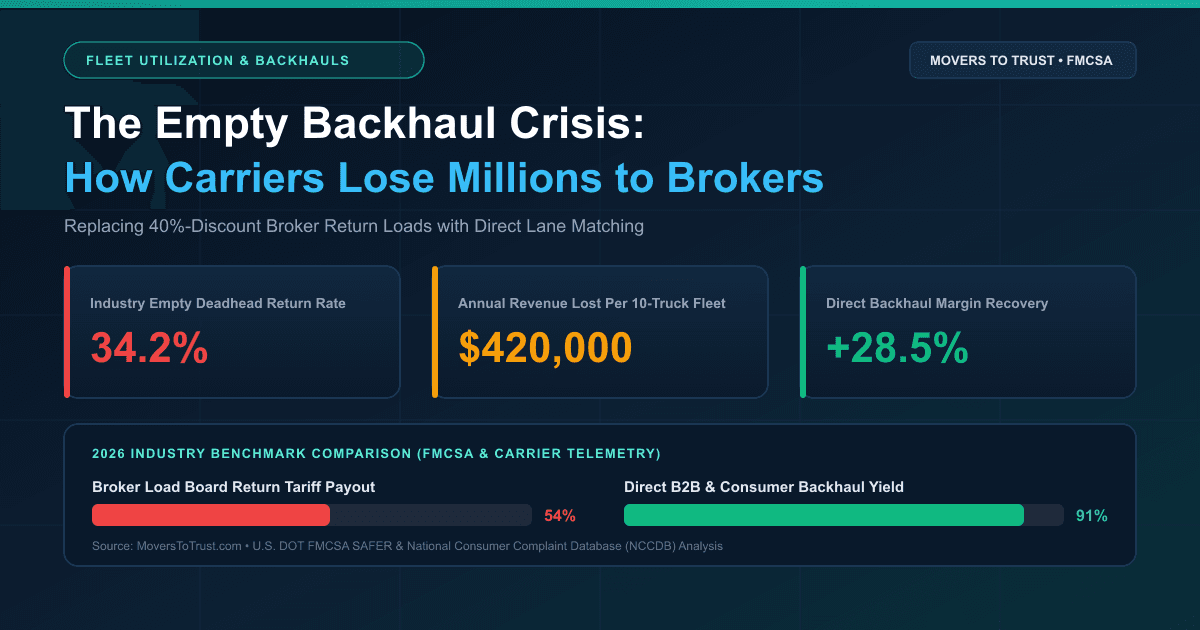
- Why 34.2% of interstate moving truck return miles run empty—costing a 10-truck fleet over $420,000 annually—and how direct carrier backhaul matching eliminates broker load-board fees.
- Core Industry Topic: empty backhaul moving industry
- Core Industry Topic: moving company backhaul loads
- Core Industry Topic: deadhead miles interstate movers
- Core Industry Topic: moving broker load boards
The empty backhaul crisis is one of the largest profit drains in the household goods moving industry: 34.2% of interstate moving truck return miles are driven completely empty (deadhead), costing a typical 10-truck motor carrier over $420,000 per year in unrecovered diesel fuel, CDL driver wages, and equipment wear—or forcing the carrier to accept discounted broker load-board jobs where the broker skims 40% to 50% of the tariff.
Why Do Legitimate Moving Trucks Drive Home Empty?
Understanding the empty backhaul problem explains why moving brokers have been able to exploit legitimate interstate moving and long-distance motor carriers for years.
Imagine an asset-based moving company headquartered in Chicago, Illinois with active USDOT authority and 12 trucks. In June, the carrier books a direct 4-bedroom household move from Chicago to Phoenix, Arizona (1,750 miles) for $8,800. The outbound trip is profitable, compliant, and smoothly executed.
However, once the crew unloads that family's furniture in Phoenix on Thursday afternoon, the Chicago carrier faces an urgent logistical dilemma: * They have zero physical sales offices or local SEO presence in Phoenix to generate a direct consumer move heading back from Phoenix to Chicago. * Driving a 53-foot tractor-trailer or 26-foot straight truck 1,750 miles back to Chicago empty (deadheading) costs $2.45 per mile in direct fuel, driver pay, insurance, and tire wear—a guaranteed $4,287 loss that wipes out the profit of the outbound trip.
2026 Fleet Telemetry Benchmark: Across mid-sized independent household goods fleets (5 to 35 power units), 34.2% of return corridor miles are run empty, while another 41.8% are filled using heavily discounted broker load-board freight that barely covers marginal fuel and driver costs.
How Moving Brokers Exploit Stranded Out-of-State Carrier Trucks
Call-center moving brokers know that an out-of-state carrier with an empty truck in Phoenix, Miami, or Dallas is desperate to cover diesel fuel on the drive home. Brokers weaponize this asymmetry: 1. The broker uses Google Ads to capture a Phoenix homeowner moving to Chicago, quoting the family $7,500 and pocketing a $3,200 upfront brokerage fee (42.6%). 2. The broker posts the remaining job on a household goods load board for $4,300—far below the $7,500 fair market tariff. 3. The stranded Chicago carrier reluctantly accepts the $4,300 subcontract just to avoid a $4,287 empty deadhead loss. 4. The broker makes $3,200 in pure profit for making one phone call, while the carrier who owns the $190,000 truck, pays the crew, buys the diesel fuel, and assumes 100% of the 49 CFR Part 375 cargo liability barely breaks even!
| Return-Lane Strategy (1,750-Mile Corridor) | Gross Revenue to Carrier | Direct Fuel, Driver & Truck Cost | Net Return-Trip Profit / (Loss) | Who Captures the Margin? |
|---|---|---|---|---|
| 1. Empty Deadhead Return (0 lbs) | $0 | -$4,287 | -$4,287 Net Loss | Nobody (100% wasted capacity) |
| 2. Broker Load Board Subcontract | $4,300 (After $3,200 broker cut) | -$5,150 (Includes loading/unloading labor) | -$850 Net Loss (Reduces deadhead loss) | Call-Center Broker ($3,200 profit) |
| 3. Direct Consumer Backhaul Match | $6,650 (10% backhaul discount to consumer) | -$5,150 | +$1,500 Net Profit | Carrier (+$1,500) & Homeowner (Saves $850) |
| 4. Verified Carrier-to-Carrier B2B Relay | $5,950 (80/20 interline split w/ peer carrier) | -$5,150 | +$800 Net Profit | Both Verified Asset Carriers |
The Solution: Direct Consumer Backhaul Matching & B2B Carrier Relays
How can legitimate motor carriers fill their return trucks without surrendering 40%+ of the tariff to a call-center broker? In 2026, Movers To Trust has introduced two broker-free backhaul engines inside the Carrier Partner Dashboard:
1. Live Return-Corridor Consumer Lead Matching
When a verified carrier posts an upcoming return lane in their Movers To Trust dashboard—for example, *"Truck #7 unloading in Phoenix, AZ on Nov 12, returning to Chicago, IL via I-40/I-55 with 1,100 cu. ft. available"*—our search algorithm and Moving Quote Analyzer automatically match homeowners searching along that exact corridor directly with the returning carrier. * Why Homeowners Love It: The homeowner gets a 10% to 15% Green Backhaul Discount directly from an inspected, asset-based carrier whose truck is already heading to their destination city—meaning faster direct delivery and zero broker middleman fees. * Why Carriers Love It: Instead of taking $4,300 from a broker, the carrier books the homeowner directly for $6,650, turning a deadhead loss into +$1,500 in net return-trip profit.
2. Verified Carrier-to-Carrier B2B Interlining (Zero Brokers)
What if another legitimate, FMCSA-verified carrier in Phoenix booked a direct customer moving to Chicago, or needs overflow capacity for a large commercial relocation, military pcs, or auto transport shipment? Through our B2B Carrier Relay & Backhaul Board, verified asset-based carriers interline loads *directly with peer carriers* under transparent 85/15 or 80/20 carrier-to-carrier revenue splits—keeping 100% of the revenue inside the legitimate trucking community and starving zero-truck brokers out of the transaction.
Frequently Asked Questions (FAQ)
Q: What is a backhaul move in the household goods moving industry?
A backhaul move occurs when an interstate moving truck that just delivered a shipment in a destination city books a return household load heading back toward its home terminal, rather than driving the truck back empty (deadheading).
Q: Can homeowners get a lower price by booking a carrier's backhaul truck directly?
Yes! When you book directly with an FMCSA-verified motor carrier that has a truck returning along your route on Movers To Trust, carriers frequently offer a 10% to 20% direct backhaul rate reduction because you are helping them eliminate empty return miles—and you get faster, dedicated point-to-point delivery.
Q: Why are broker load boards bad for independent moving carriers?
Broker load boards take advantage of carriers stranded out of state by skimming 35% to 50% of the customer's moving payment as an upfront brokerage fee, leaving the actual carrier with sub-tariff payout rates that barely cover fuel and driver wages.
Q: How can my moving company post available backhaul capacity on Movers To Trust?
Once you claim and verify your USDOT profile, open your Carrier Dashboard and add your upcoming origin city, destination corridor, available cubic footage, and departure dates to the Live Backhaul & B2B Relay Board to receive direct homeowner and peer-carrier matches.
Did you find this guide helpful?
Share it to help homeowners and carriers verify credentials and bypass rogue brokers.
Verified Sources & Citations
In alignment with Google's E-E-A-T and Generative Engine Optimization (GEO) citation standards, this article cites the following verified authority sources: