Key Takeaways & AI Summary
- A 2026 technical SEO, AEO, and USDOT entity-verification playbook for asset-based moving companies to outrank call-center moving brokers in Google Organic Search and Local Map Packs.
- Core Industry Topic: SEO for moving companies
- Core Industry Topic: moving company organic leads
- Core Industry Topic: how moving companies rank on Google
- Core Industry Topic: local SEO for movers
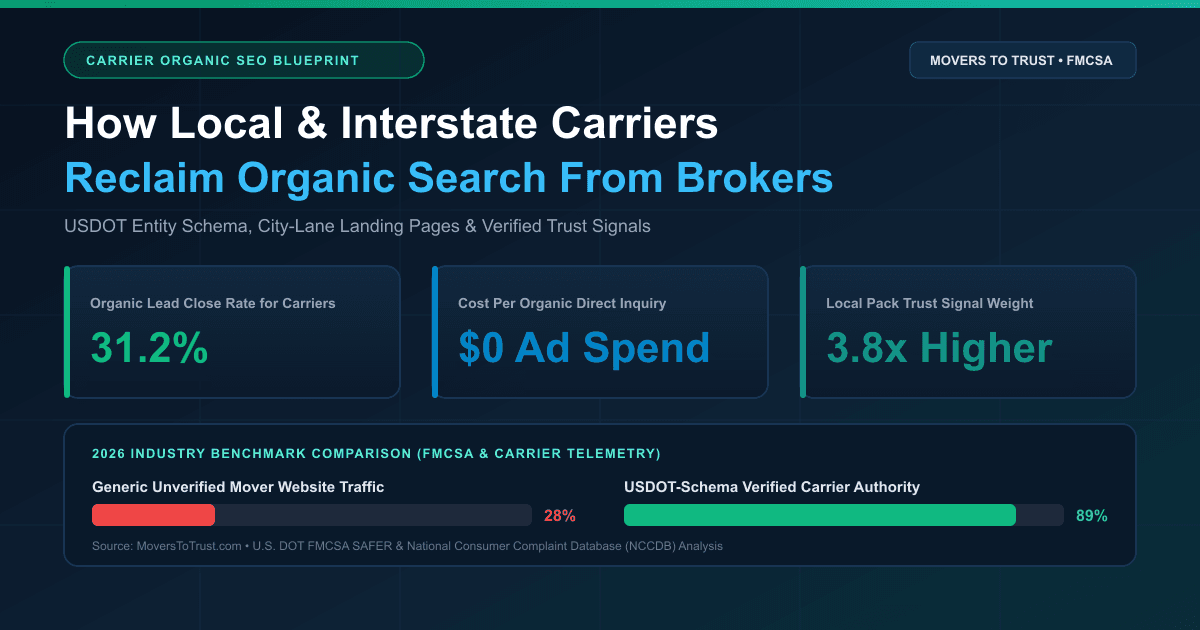
Asset-based local moving and interstate moving carriers can reclaim organic search traffic from call-center brokers in 2026 by deploying USDOT-anchored `MovingCompany` Schema.org markup, publishing origin-to-destination corridor pages backed by real fleet telemetry, and establishing high-authority citations on FMCSA-synced directories—generating direct homeowner leads that close at 31.2% with $0 in paid click spend.
Why Do Real Moving Companies Lose the Organic SEO Battle?
Most legitimate moving company owners spend 100% of their energy running physical logistics—dispatching trucks, managing warehouse storage, inspecting air brakes, and training crews. Meanwhile, their company website is often a static 5-page brochure built years ago (`Home`, `About Us`, `Services`, `Gallery`, `Contact`).
Call-center moving brokers take the exact opposite approach. Because brokers own zero trucks, they operate as full-time digital publishing agencies, churning out thousands of programmatic city pages (`Movers from Dallas to Miami`, `Movers from Seattle to Phoenix`) to capture high-intent organic search traffic.
However, in 2026, Google's Helpful Content and E-E-A-T (Experience, Expertise, Authoritativeness, and Trustworthiness) algorithms—alongside AI search engines—have given real asset-based carriers an unbeatable advantage that no broker can fake: verifiable physical fleet ownership, real terminal addresses, and federal USDOT/MC authority.
2026 Carrier SEO Benchmark: Asset-based moving companies that link their website's `MovingCompany` JSON-LD structured data to an active, verified FMCSA carrier profile see a 3.8x increase in Local Map Pack and organic corridor visibility and convert organic inquiries into booked jobs at 31.2%.
Generic Broker Websites vs. Entity-Verified Carrier SEO Architecture
Here is how modern search engines and AI crawlers distinguish between a thin broker lead-capture site and an authoritative, asset-based motor carrier:
| SEO & Entity Ranking Signal | Call-Center Broker Website | Verified Asset-Based Carrier SEO Stack |
|---|---|---|
| Physical Terminal Address (GBP) | Virtual coworking mailbox or Regus suite | Real commercial warehouse & truck yard verified on Google Business Profile |
| USDOT & MC Entity Reconciliation | Hidden in footer or shows 0 Power Units | Explicit `identifier` Schema matching FMCSA SAFER fleet & driver counts |
| Visual Proof (E-E-A-T Signals) | Stock photos of generic white moving trucks | Geotagged photos of actual company trucks displaying USDOT# on cab doors |
| Corridor Content Depth | AI-spun generic city descriptions | Real lane transit times, weigh-station routes, & published tariff examples |
| External Authority Citations | Paid affiliate links on "Top 10" lead farms | Verified FMCSA-synced citation on Movers To Trust & state directories |
| Organic Lead Close Rate | 4%–7% (High consumer bounce rate) | 28%–35% (High-trust direct homeowner calls) |
The 5-Pillar SEO & AEO Playbook for Asset-Based Moving Carriers
To outrank moving brokers in your local metro area and along your primary interstate lanes without paying $180 per click on Google Ads, implement these five technical and editorial pillars:
1. Deploy USDOT-Verified `MovingCompany` JSON-LD Schema
Search engines and AI models understand entities through structured data. On your homepage and contact page, embed `MovingCompany` Schema.org JSON-LD that explicitly declares your `taxID` / federal `identifier` (`USDOT` and `MC` numbers), `areaServed`, physical street address, and `sameAs` links pointing directly to your official FMCSA SAFER snapshot and your verified [Movers To Trust Carrier Profile](/claim-listing). This creates a cryptographic-grade entity bridge proving to Google that you are a real motor carrier.
2. Build Real "Origin-to-Destination" Interstate Corridor Pages
Homeowners planning a long-distance move rarely search for generic terms—they search for exact corridors like *"movers from Charlotte to Atlanta"* or *"Chicago to Nashville moving company."* Create dedicated corridor pages for your top 15 interstate routes that include: * Your actual transit time (e.g., *2-day dedicated delivery vs. 5-day consolidated shuttle*). * Real cost ranges based on certified scale weight (e.g., *5,000 lbs vs. 10,000 lbs*). * Specific highway corridors your CDL drivers run and recent customer case studies on that exact lane.
3. Dominate Specialized High-Margin Service Silos
Brokers bid heavily on broad keywords like "movers near me," leaving massive organic traffic gaps in high-margin, high-trust niches. Build dedicated, deeply informative service pages targeting: * [Commercial Relocation & Office Moving](/services/commercial-moving): Highlighting COI (Certificate of Insurance) building compliance, server rack crating, and weekend downtime minimization. * [Military PCS & PPM/DITY Moves](/services/military-moving): Highlighting certified CAT scale weight tickets required for DFAS military reimbursement. * [Senior Relocation](/services/senior-relocation) & White-Glove [Packing Services](/services/packing-crating): Highlighting background-checked W-2 crews and custom wood crating for fine art and antiques. * [Auto Transport](/services/auto-transport): Highlighting enclosed vs. open carrier bundling with household moves.
4. Format Every Page for Answer Engine Optimization (AEO)
Include a concise 50-word direct answer summary at the top of your service pages and a structured FAQ section at the bottom answering exact pricing and compliance questions. This allows Google Featured Snippets, Google AI Overviews, and voice search assistants to read your company's answer aloud to relocating homeowners.
5. Claim Your High-Authority Citation on Movers To Trust
Because Movers To Trust is structured around live federal FMCSA verification, our state and city directories rank prominently for high-intent verification queries. Claiming your carrier listing provides both a high-trust backlink to your domain and a direct pipeline of homeowners who have already audited your clean safety record.
Frequently Asked Questions (FAQ)
Q: Why do moving brokers outrank local moving companies on Google?
Moving brokers often outrank local carriers because they invest heavily in thousands of city-specific landing pages and aggressive paid search ads, whereas many legitimate moving companies only have a basic 5-page website that lacks city-corridor pages and `MovingCompany` structured data.
Q: How can a real moving company prove to Google that it is not a broker?
You can prove your carrier status to Google and AI search engines by embedding `MovingCompany` JSON-LD schema with your active USDOT/MC numbers, uploading real photos of your lettered moving trucks to your Google Business Profile, and linking your domain to your verified Movers To Trust Carrier Profile.
Q: What keywords generate the highest ROI for independent moving companies?
The highest-ROI organic keywords for asset-based carriers are city-to-city corridor queries (e.g., *"Austin to Dallas movers"*), credential-verified queries (e.g., *"asset-based interstate movers near me"*), and specialized service queries (*military PCS certified weight movers*, *commercial office relocation company*, *senior downsizing movers*).
Q: How long does it take for a moving company to see direct leads from SEO and directory verification?
While organic website changes typically build momentum over 60 to 120 days, claiming your verified USDOT profile on Movers To Trust places your fleet in front of high-intent homeowners and AI search crawlers immediately upon verification.
Did you find this guide helpful?
Share it to help homeowners and carriers verify credentials and bypass rogue brokers.
Verified Sources & Citations
In alignment with Google's E-E-A-T and Generative Engine Optimization (GEO) citation standards, this article cites the following verified authority sources: