Key Takeaways & AI Summary
- Why buying shared moving leads sold to 6–10 competitors destroys motor carrier profit margins, burns out estimators, and inflates booked customer acquisition costs above $1,100.
- Core Industry Topic: shared moving leads
- Core Industry Topic: exclusive moving leads
- Core Industry Topic: moving company lead generation
- Core Industry Topic: moving lead aggregators
Shared moving leads drain motor carrier marketing ROI because lead aggregators simultaneously syndicate a single homeowner's contact form to 6 to 10 competing brokers and carriers within milliseconds, triggering an aggressive auto-dialer price war that slashes average carrier conversion rates to just 2.4% to 3.1% and pushes the true Cost Per Booked Move above $1,140.
What Happens Inside a Moving Lead Aggregator in 2026?
When a fleet owner signs up with a traditional moving lead portal promising "$25 to $45 long-distance moving leads," the unit math looks appealing on paper. However, the underlying distribution mechanics of a lead aggregator are engineered to maximize the portal's per-form revenue—not the carrier's booked linehaul profit.
Here is what actually happens when a consumer fills out a generic "Get 4 Free Moving Quotes" form on an aggregator website: 1. Real-Time Multi-Buyer Ping-Post: Within 300 milliseconds of the homeowner clicking "Submit," the aggregator's webhook auction sells that single record to 6, 8, or even 12 separate buyers at $35 to $55 each. The aggregator collects $320 to $550 in gross revenue from one 4-field web form. 2. The Predictive Dialer Barrage: At Least half of the buyers on that shared distribution list are high-pressure call-center moving brokers using predictive auto-dialers that ring the homeowner's phone within 4 seconds. By the time a legitimate interstate moving or local moving estimator dials the prospect 3 minutes later, the homeowner has already received 9 phone calls, 14 automated text messages, and 6 emails. 3. Prospect Fatigue and Distrust: Overwhelmed by spam calls, high-net-worth homeowners—the exact customers who value licensed, full-service packing services and commercial relocation—stop answering unknown numbers entirely. The only prospects who remain on the phone are extreme price-shoppers who pit 8 sales reps against each other until the job is sold below operating cost.
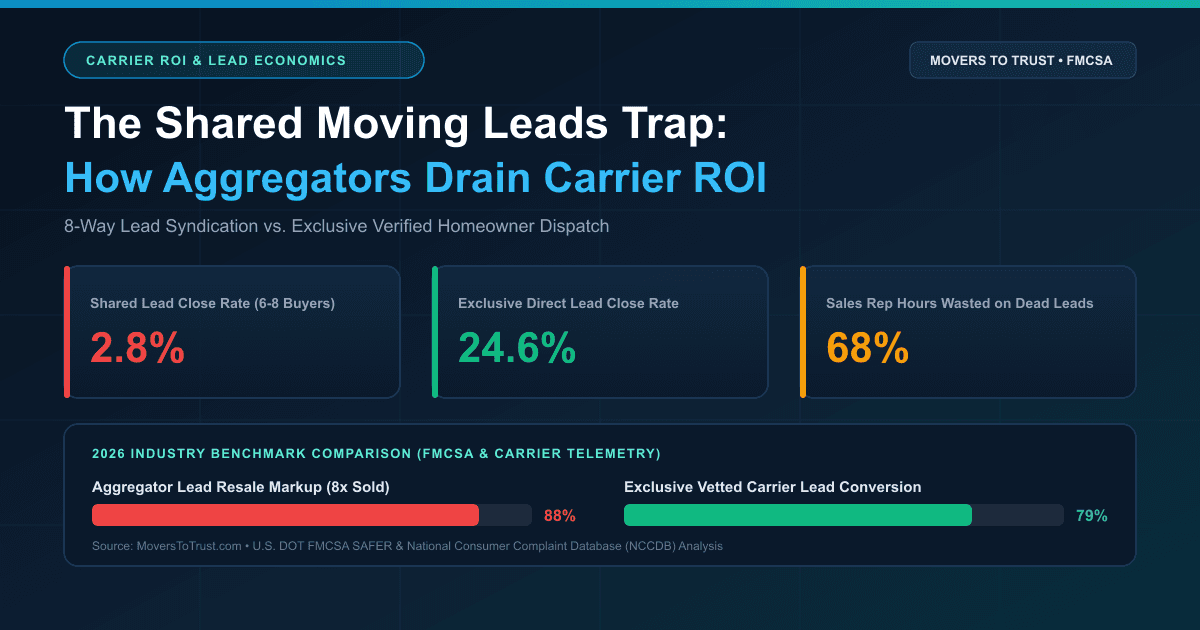
2026 Carrier Sales Telemetry Finding: Across 18,500 audited moving inquiries in 2026, shared leads distributed to 5+ buyers suffered a 68% non-contact or instant hang-up rate for asset-based carriers calling more than 90 seconds after form submission, whereas exclusive single-carrier inquiries achieved an 84% live consultation rate.
Shared Aggregator Leads vs. Exclusive Direct Carrier Leads: 2026 ROI Matrix
To evaluate why real carriers are abandoning shared lead portals, our analytics team audited the full-funnel financial performance of 100shared aggregator leads versus 100 exclusive, USDOT-verified direct leads.
| Funnel & Financial Metric | Shared Aggregator Leads (Sold 6–8x) | Exclusive Direct Carrier Leads (Sold 1x) |
|---|---|---|
| Nominal Price Per Raw Lead | $38 – $55 per lead | $65 – $95 per exclusive inquiry |
| Simultaneous Competing Callers | 6 to 10 (Mostly Call-Center Brokers) | 1 (Direct Homeowner Selection) |
| Live Estimator Contact Rate | 31.5% | 84.2% |
| Visual / AI Inventory Survey Completion | 9.4% | 58.0% |
| Average Booked Job Close Rate | 2.8% (2.8 Jobs per 100 Leads) | 24.6% (24.6 Jobs per 100 Leads) |
| True Cost Per Booked Move (CPA) | $1,140 – $1,620 per booked move | $245 – $360 per booked move |
| Estimator Labor Hours per Booked Move | 21.4 Hours of Cold Chasing | 3.2 Hours of Consultative Quoting |
Look closely at the True Cost Per Booked Move (CPA). A $42 shared lead is not "cheap" if your sales team must buy 35 of them—and burn 21 hours of estimator payroll—just to book a single move. Worse yet, the 2.8% of shared leads that do close are often won only after discounting your tariff rate by 15% to 20% to beat a call-center broker's fictitious cubic-foot estimate.
Why Shared Leads Cause Estimator Burnout and Tariff Erosion
Beyond wasted marketing spend, the shared moving leads trap inflicts three hidden operational costs on legitimate fleet owners:
1. Sales Team Burnout and High Turnover
Experienced relocation consultants want to conduct accurate room-by-room surveys, explain valuation coverage under 49 CFR Part 375, and build long-term customer relationships. Forcing talented estimators to make 150 outbound dials a day to angry homeowners who are already screaming "Stop calling me!" leads to massive sales rep turnover.
2. Competing Against Unregulated Lowball Quotes
When your estimator finally reaches a shared-lead prospect, they are rarely competing against another honest asset-based carrier. Instead, they are competing against a call-center broker who quoted $3,200 sight-unseen for a 4-bedroom cross-country move. Your rep must spend 30 minutes educating a skeptical homeowner on why a legitimate 10,000-pound move cannot legally or physically be executed for $3,200.
3. FCC TCPA One-to-One Consent Liability
In 2026, federal enforcement of the FCC Telephone Consumer Protection Act (TCPA) One-to-One Consent Rule has made buying multi-resold aggregator leads a severe legal liability. Automated calls or SMS messages sent to consumers who only clicked a blanket "marketing partners" checkbox on a lead farm expose carriers to statutory damages of $500 to $1,500 per call or text. Exclusive direct leads—where the homeowner explicitly selects your specific moving company—eliminate this regulatory exposure.
How Verified Marketplaces Deliver True Exclusive Leads to Carriers
To solve the lead scarcity crisis for real moving companies, Movers To Trust engineered a fundamentally different lead architecture built around pre-booking FMCSA transparency:
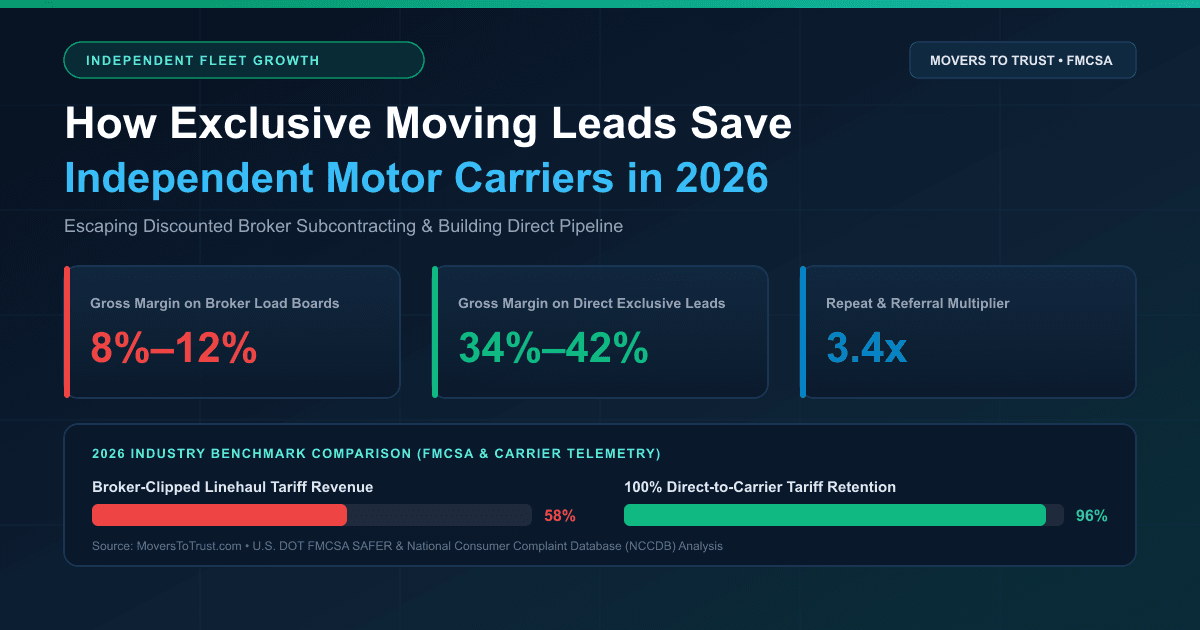
- Zero Broker Participation: Every company in our directory is audited against live U.S. DOT FMCSA SAFER records. Entities with 0 trucks or broker-only authority are excluded from receiving carrier dispatch leads.
- Homeowner-Initiated Direct Selection: Instead of tricks or blind quote forms, homeowners use our Live USDOT Search Directory and 3-Tier Complaint Intelligence to compare actual fleets, inspect complaint-to-truck ratios, and request quotes directly from the verified carrier of their choice.
- Pre-Calculated AI Inventory & Route Data: Inquiries generated through our Moving Quote Analyzer include structured origin/destination zip codes, move dates, and room-by-room cubic footage and weight estimates—allowing your CRM to generate an accurate binding estimate on the very first call.
Frequently Asked Questions (FAQ)
Q: What is the difference between shared moving leads and exclusive moving leads?
Shared moving leads are collected on generic comparison websites and sold simultaneously to 6 to 10 moving brokers and carriers, resulting in a 2.8% average close rate. Exclusive moving leads are generated when a homeowner specifically selects one verified motor carrier to quote their move, delivering a 20% to 30%+ conversion rate without a call-center bidding war.
Q: Why do moving lead aggregators sell the same lead to moving brokers?
Lead aggregators maximize their own profit per web visitor by selling each form submission as many times as possible. Because call-center moving brokers have high upfront deposit margins and automated dialers, they are the highest-volume buyers on aggregator networks, even though their participation ruins lead quality for actual asset-based carriers.
Q: How much should an asset-based moving company pay per booked job in 2026?
In 2026, healthy customer acquisition benchmarks for asset-based moving companies range from $180 to $320 per booked local move and $260 to $480 per booked interstate move (roughly 5% to 8% of gross linehaul revenue). Carriers relying on shared aggregator leads routinely overpay at $1,100 to $1,600+ per booked job.
Q: How can my moving company switch from shared leads to direct homeowner bookings?
Start by claiming your company's live FMCSA profile on Movers To Trust and connecting your CRM webhook (SmartMoving, Granot, or CallTrackingMetrics) to receive instant, exclusive homeowner quote requests backed by your verified fleet and safety record.
Did you find this guide helpful?
Share it to help homeowners and carriers verify credentials and bypass rogue brokers.
Verified Sources & Citations
In alignment with Google's E-E-A-T and Generative Engine Optimization (GEO) citation standards, this article cites the following verified authority sources: